What Are Quilting Needles? A Beginner's Guide for New Quilters
Quilting Needles for Beginners: Why You Need Them (vs Universal)
Have you ever sat down at your sewing machine, all set to do some relaxing quilting... only to find your stitches are skipping, your thread keeps breaking, or your machine sounds like it's complaining at you? It's frustrating, isn't it?
Nine times out of ten, the answer is hiding in the smallest part of your machine: the needle.
Today I want to talk you through quilting needles: what they actually are, why they're different from the standard needle that probably came with your machine, and how choosing the right one can completely transform the way your machine sews through a quilt.
By the end of this post, you'll know exactly what to look for next time you're picking up a packet of needles, and why it matters.
Brand new to quilting?
Grab my free Beginner Quilter's Quick Start Toolkit, it's packed with the basics you need to start your quilting journey with confidence. 👉 Download it here.
What Is a Quilting Needle?
A quilting needle isn't just a universal needle with a fancy name. It's a specialist tool, designed specifically for the "quilt sandwich" we make when we put our quilts together.
If you'd like the full side-by-side comparison, I've got a separate post covering exactly that: Quilting vs Regular Needles: Everything Beginners Need to Know.
Two things make it different from a standard sewing machine needle, so let's look at each one:
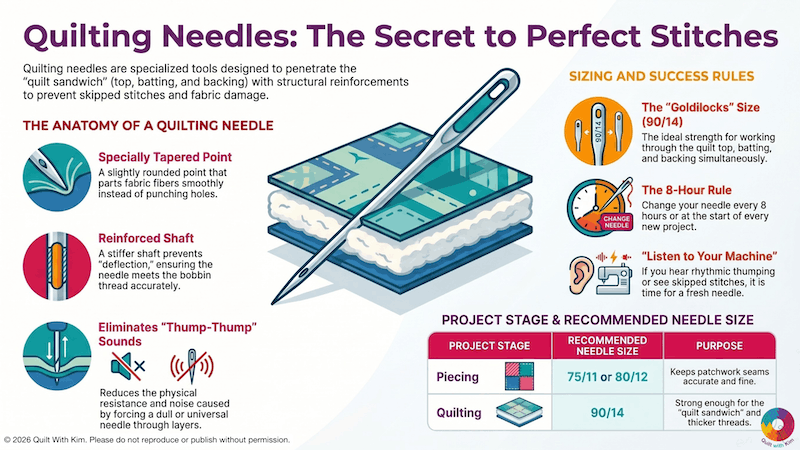
1. A Specially Tapered Point
A quilting needle has a tapered, slightly rounded point. This shape allows the needle to part the fibres of your fabric and slide through smoothly, rather than punching a heavy hole through them.
Why does that matter?
Because when you're quilting, your needle isn't just going through one layer of fabric. It's working much, much harder than that.
2. A Reinforced Shaft
This is the secret sauce. The shaft of a quilting needle is slightly stronger and stiffer than a standard universal needle, which helps it stay nice and straight as it works through thick layers.
A standard ("universal") needle can bend a tiny amount when it hits a thick seam (the technical term is "deflection"). If the needle bends, even just a smidge, it won't meet the bobbin thread at exactly the right moment, and that's when you get those annoying skipped stitches.
Why a Quilting Needle Really Matters
When you're machine quilting, your needle has a big job to do. It has to pass through:
• Your quilt top (which often includes seams stacked on top of seams);
• The wadding or batting in the middle;
• The backing fabric on the bottom.
That's at least three layers, sometimes more in the seam areas. A standard universal needle can really struggle with this, and you'll often notice the signs:
• Skipped stitches (especially as you cross over a seam);
• A dull "thump-thump" sound as the needle hits the fabric;
• Broken needles, particularly when sewing over thicker areas;
• Snagged or pulled threads on your beautiful quilt top 😥
• Broken needles, particularly when sewing over thicker areas;
• Snagged or pulled threads on your beautiful quilt top 😥
Switching to a proper quilting needle is one of the simplest changes you can make, and it solves so many of these little headaches in one go.
💡 A Quick Tip from Me
When you're machine quilting, don't forget to increase your stitch length to 3.0, 3.5 or even 4.0mm. A longer stitch length helps your stitches sit beautifully across all those layers, and it's a tiny change that makes a really big difference.
🎥 Want to See It in Action?
Sometimes it's so much easier to see something than read about it, isn't it?
I've put together a short YouTube video on quilting needles that walks through everything we've just covered, including a closer look at that tapered point and why those skipped stitches happen. You can have a watch right here:
Choosing the Right Size of Quilting Needle
Once you know you need a quilting needle, the next question is: what size?
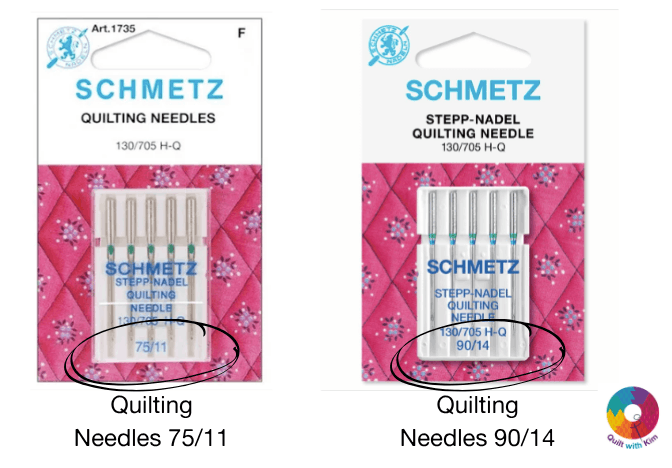
Needle sizes usually have two numbers, like 75/11 or 90/14. The first number is the European size (the higher the number, the thicker and stronger the needle); the second is the American equivalent. Don't worry about memorising both, just look at the front of the packet.
For beginners, here's the simplest way to think about it:
• Size 75/11: Lovely for piecing your patchwork. Thin enough to keep your seams nice and accurate, but strong enough to handle good quality cotton fabric.
• Size 90/14: This is your "Goldilocks" size for the actual quilting stage. Strong enough to work through the top, wadding and backing without any complaints.
If you're using a thicker decorative thread for your quilting stitches, the 90/14 will also be much happier carrying that thread through the layers.
If you'd like a deeper dive into needle sizes and how to match them to your project, have a read of my full guide here: Quilting Needle Size — A Guide For Beginners.
My Golden Rules for Needle Success
Before you head off to your sewing room, here are a few simple habits that will save you so much frustration down the line:
1. Change your needle often. A sewing machine needle is at its best for around 8 hours of stitching. Pop a fresh one in at the start of every new project, it's the cheapest insurance for your quilt.
2. Listen to your machine. If your machine starts making a "thump-thump" sound as it sews, the needle is most likely dull. Time for a fresh one.
3. Match your needle to your thread. Thicker thread? Use a slightly larger needle. Fine thread? A smaller one will do beautifully.
4. Don't force it. When you reach a thick seam, slow right down and let the needle do its job. Pulling or tugging the fabric is what often leads to broken needles.
5. Keep a few sizes on hand. A small stash of 75/11 and 90/14 quilting needles in your sewing box means you'll never get caught short halfway through a project.
Quick Recap
- A quilting needle has a tapered point and a reinforced shaft, designed specifically for stitching through multiple layers.
- It helps prevent skipped stitches, broken needles, and snagged threads on your quilt top.
- Use 75/11 for piecing, and 90/14 for the actual quilting.
- Increase your stitch length to 3.0 or 3.5mm (or even 4.0mm) when machine quilting.
- Change your needle regularly; fresh needles make happy machines.
Ready to start quilting with confidence?
Download my free Beginner Quilter's Quick Start Toolkit, your friendly guide to the tools, terms and techniques every new quilter needs. Grab your copy here: 👉 Download it here.
See you next time,
Kim xx
Kim xx

Kim Reynolds
05/04/2026 16:30:00 +0000
Kim Reynolds - Founder of Quilt With Kim
Kim is the founder of Quilt With Kim, a trusted resource for quilting beginners. With over seven years of experience inspiring students to explore their creativity, Kim specialises in teaching patchwork and quilting through easy-to-follow courses and tutorials.
She holds a City & Guilds qualification in Patchwork & Quilting and loves helping beginners create their first quilts with confidence.
Kim also hosts a popular YouTube channel, Quilt With Kim, where she shares tutorials and tips tailored to beginners. She has also taught patchwork live on air on Sewing Street on TV.
Based in Gloucestershire, UK, Kim enjoys yoga, cooking, and seaside and country walks with her husband, Nige. Her chief quilting assistant, Shadow the cat, is always on hand to supervise her projects.
Download the FREE Beginner Quilter's Toolkit - a free guide to help you to know how to get started with quilting and to join Kim's newsletter list and begin your quilting journey today.
Confused About What Equipment You Need To Get Started With Patchwork & Quilting?
Discover the 14 essential tools and equipment you need as beginner in patchwork and quilting.
Download your FREE copy today.
PLUS comes with handy print out shopping guide!
Get In Touch
Dedicated email coming soon
2023 - 2024 The Patchwork Shop Ltd | All Rights Reserved.
The Patchwork Shop Ltd T/A Quilt With Kim | Registered in England | Company Number 10630597